Another Letter to UN Human Rights Council Calls for International Probe on Sri Lanka
23-Aug-2025.
A fresh appeal has been sent to the United Nations Human Rights Council (UNHRC) by Tamil representatives, urging an international investigation into alleged crimes committed by the Sri Lankan government.
The letter was addressed to the UN High Commissioner for Human Rights as well as to the permanent and observer member states of the Council.
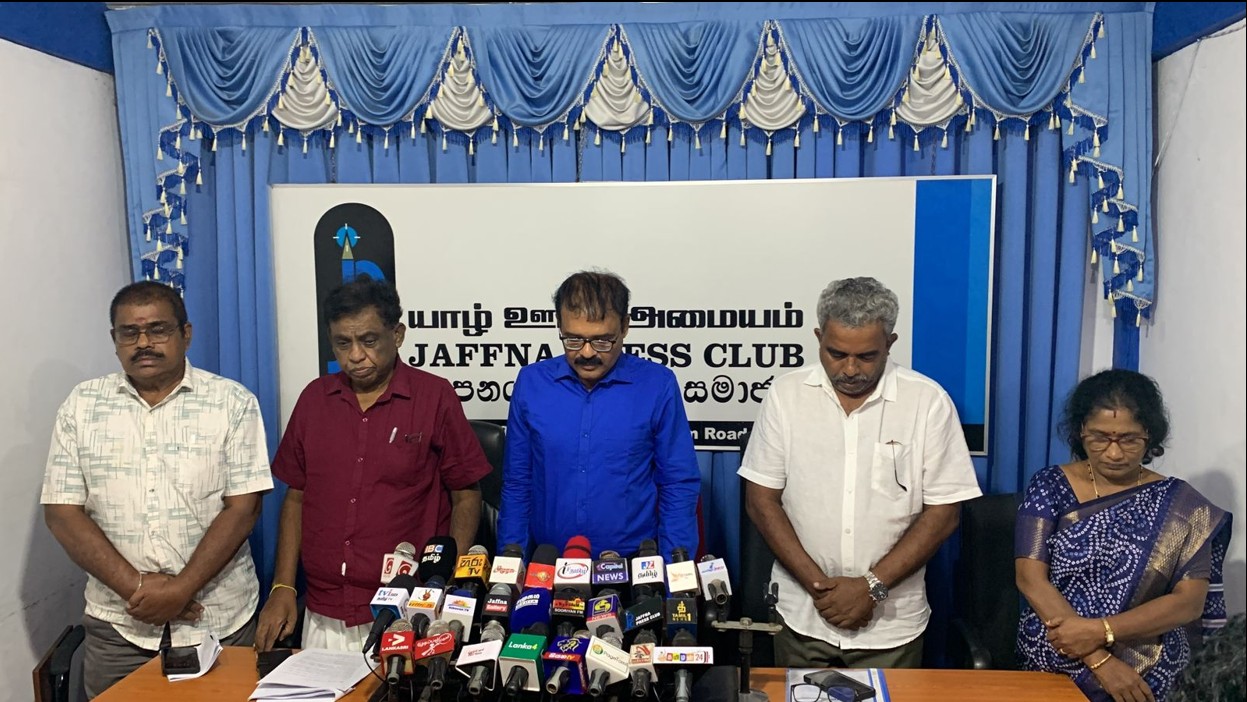
The appeal bears the signatures of parliamentarians, political leaders, religious figures, and civil society representatives. It was formally announced at a press briefing held in Jaffna on August 21, 2025.
The letter refers to the 60th Session of the UN Human Rights Council and stresses the urgent need for international mechanisms to ensure accountability.
Key Demands in the Letter are as follow:
Establishment of an International Mechanism
The signatories called for the creation of an International Independent Investigative Mechanism (IIIM) with full authority under the 1948 Genocide Convention to examine whether genocidal crimes were committed against the Tamil people of Sri Lanka’s Northern and Eastern provinces. They argued that Sri Lanka’s actions were aimed, in whole or in part, at destroying the Tamil population, while simultaneously blocking any credible domestic inquiry.
The appeal reminded the Council that since the Kalloori massacres of June 1956—the first major anti-Tamil pogrom—Tamils have consistently requested such an international body. The letter emphasized that only an independent investigation could establish accountability and provide answers to the long-standing suffering of families of the disappeared.
Any involvement of the Sri Lankan state in such investigations, the letter noted, would be inherently biased, since those accused of the crimes are state officials and state-affiliated actors themselves.
Referral to the International Court of Justice (ICJ)
The Tamil representatives urged UNHRC members and observer states to initiate proceedings at the ICJ under Article IX of the Genocide Convention, to establish Sri Lanka’s responsibility for genocide against the Tamil people.
Reports such as the UN Panel of Experts Report (2011), the OISL Report (2015), and the findings of the UN Special Rapporteur on Torture (2007) were cited as evidence that war crimes and crimes against humanity committed by Sri Lanka’s armed forces could not have occurred without state complicity at the highest level.
The letter noted that Sri Lanka ratified the Genocide Convention in October 1950, giving UNHRC members the legal authority to bring such a case.
Independent Oversight of Mass Graves
Highlighting the mass grave site at Chemmani in northern Sri Lanka, the letter requested the appointment of an international expert group, under the Bournemouth Protocol on Mass Graves, to supervise excavations and ensure impartial handling of evidence.
It argued that state-led inquiries cannot be trusted, citing past instances where evidence of unlawful killings was tampered with or destroyed. The Chemmani site, it noted, contains remains of Tamil civilians—including children—who were abducted, tortured, and killed.
Repeal of Repressive Laws
The letter also called on the Council to press Sri Lanka to repeal the 6th Amendment to the Constitution (1983), which criminalizes peaceful advocacy for self-determination, in violation of the ICCPR. It further urged a time-bound repeal of the Prevention of Terrorism Act (PTA), which continues to be used to detain Tamil activists, journalists, and civilians.
The representatives warned that Sri Lanka has used such laws, as well as policies promoting Sinhalese settlement in Tamil areas, to silence democratic political expression and undermine the Tamil people’s fundamental rights.
Final Recommendations: The letter urged the 60th Session of the UNHRC to adopt a resolution that includes the following:
Establishment of an independent international investigative mechanism (IIIM) with full temporal jurisdiction under the Genocide Convention.
Initiation of a case against Sri Lanka at the ICJ by at least one UN member or observer state.
Appointment of an international expert panel under the Bournemouth Protocol to oversee investigations into mass graves such as Chemmani.
A strong call to halt the enactment or enforcement of laws that contravene international human rights and humanitarian obligations, including the repeal of the 6th Amendment and a time-bound removal of the PTA.
The letter concludes by affirming that the Tamil people continue to hold faith in international humanitarian law and insist that the UN must act decisively to ensure justice and accountability.